

|
|

Page 2 of 2:
Candle
Pinching
During the Spring, the buds that you have retained will elongate
into candles, their size being in relation to each candle's individual
strength and vigour. To ensure that growth extension is regulated
and energy is dispersed evenly throughout the whole tree; these
candles need to be pinched back. The amount that each candle is
reduced depends on its position within the structure of the tree
and its future purpose. After the candles have extended into new
shoots and branches, it is at their tips that new buds for next
year will form.
Just as in bud selection, candles growing in more vigorous areas
of the tree should be reduced by far more than candles growing
in weaker, inner areas. If a new branch or sub-branch is required
the candle can be left unpruned to extend; however it should be
noted that more of the trees energy will be directed to it at
the expense of other areas. Candles left unpruned to encourage
vigour in weak areas or to develop new branches can then be cut
back to a desirable length once they have fully elongated and
hardened, this will soon be followed by the appearance of buds
at the tip.
The timing of pinching out candles will affect where the new buds
that follow will form. Pinching the candles before the new needles
appear will cause new needles to form at the base of the candle.
Pinching the candles after the needles begin to appear and start
to elongate will cause the buds that follow to form at the end
of the new shoot.
Don't pinch out all the candles at once. Start pinching out the
weaker areas of the tree first and finish with the strongest areas
2-3 weeks later. Generally, as a rule of thumb, candles growing
in vigorous areas of a Pine should be reduced by at least 1/2
to 2/3, candles in weak areas should be reduced by no more than
a 1/3.
Needle Plucking
Needle plucking is a very useful tool for pine maintenance. It allows air and light to penetrate the outer foliage to increase the health and vigour of inner shoots and branches. It also helps to spread energy throughout the tree in the same way that bud selection and candle pinching do.Combined with pruning of the current years growth on a Pine bonsai, needle-plucking is also the best way of prompting backbudding as well as controlling the height and width of a pine bonsai.
Timing is important; it should be carried out after the new growth of the current growing-season has extended, from mid-July (late-Summer) until Autumn.Both old and new needles are plucked according to their position on the tree. The principal behind needle plucking is that the more foliage or needles a branch has, the more vigorous it is; by reducing the amount of needles on a vigorous area of the tree (such as the apex) in comparison to the number of needles a weak area has, vigour is distributed more evenly.
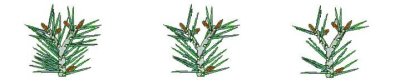
From left to right
Image 1: Lower or inner shoot
Image 2: Mid-level shoot
Image 3: Upper or Outer shoot
As a basic rule leave less needle-pairs on the upper shoots and more on the weaker, lower and inner shoots. Often no needles are plucked from inner shoots to preserve their vigour. The actual numbers of needles that are removed will depend on the needs and strength of the tree. With a very vigorous tree it may be possible to leave as little as 4 pairs of needles on the upper branches, 6 or 7 pairs on the mid-level branches and 8-12 on the lower branches. Base your starting number on the lowest, weakest shoots since you can only decrease strength with this technique and not increase it. Do not remove so many needles that the overall vigour of the tree or branch is lost.Late Summer Pine Pruning: Needle Plucking and Shoot Trimming
Shoot Trimming and Forcing Back-Budding
To force a Pine to back-bud is ordinarily difficult . However, shoot trimming is a useful technique for trying to force back budding and generally increasing the number of buds on a tree.
In late Summer, the current years' growth is pruned. New shoots are pruned according to the desired length of the enthusiast; where a longer branch or shoot is required the new shoot might even be left unpruned. Where ramification (or density of buds) or containment of the size of a branch is required, the new shoot might be pruned right back leaving just 2 or 3 sets of new needles.It is at this point, where needles are left at the tip of the newly pruned growth, that the shoot will produce new buds through the Winter and following Spring. It can also cause the tree to produce buds further back along the branch, where old needles have been recently plucked or sometimes even on old wood.
Late Summer Pine Pruning: Needle Plucking and Shoot Trimming
NEEDLE
REDUCTION
It is often necessary with all but the largest Pine bonsai to
reduce the length of the needles to help refine the image of the
tree.
It has often been that recommended that needle reduction can be
achieved by reducing the amount of water and fertiliser available
to the tree during the Spring so that new needle growth is limited;
literally 'starving' the tree. This is not a satisfactory technique
as it entails deliberately weakening the tree and reducing its
vigour for a number of weeks.
These days, there is a new technique which helps reduce the length
of needles by limiting the time the tree has to grow it needles
before growth slows or stops for the Winter.
Allow shoots to grow through the Spring and Summer. In mid-Summer,
cut the new shoots leaving only last year's needles. Over the
course of the next few weeks new buds will form; these will need
to be reduced to two as outlined previously. These new buds will
not develop into candles, but will sprout new needles as soon
as possible. They will not have enough time in the remainder of
the season to grow long resulting in a set of reduced needles.
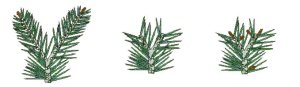
From left to right:
Image 1: Two candles
that have been allowed to fully extend into shoots.
Image 2: After trimming back in Summer
Image 3: Resulting buds.
This technique should only be carried out on Pines that have an established trunk and branch structure. Using this technique will decrease the vigour of the tree and its ability to thicken up branches and trunks; needle reduction should be regarded as the last stage of developing a pine bonsai.